A letter to my representatives
State Representative Phillips and State Senator Mullica,
I’m reaching out as a parent of a child in the Adams 12 school district and as a resident of your house and senate districts. While I’m extremely grateful that the Joint Budget Committee has managed to avoid major cuts to K-12 districts, deeply problematic cuts have still been made in other areas of public education while increased funding is provided to other areas of state government that hurt families. I ask you to vote against cutting other impacted education initiatives and to vote against funding problematic offices and departments in the state.
Problematic Cuts
The Center for Rural Education has proved to be an invaluable asset for prospective and current rural educators and, thus, rural districts. Through grants from the State of Colorado, they help recruit future rural educators, support rural teachers in training, and support current teachers in accessing continued learning opportunities to help them meet the needs of a swiftly changing student demographic. The budget they receive from the state is a modest $1.2 million dollars a year.
The Teacher Recruitment and Education Program (TREP), too, has been an excellent resource in helping the state prepare the next generation of educators in the United States. The program is designed to provide high school students with concurrent enrollment credits while they are pursuing education licensure. The TREP program enjoyed a swift increase in student participation, opening college access to a growing population of students since 2022. They began with a total of 50 participants in 2022 and are currently at 221 participants in 2026. The per student cost is $10,841, but if you take this number and multiply it by 221, that’s roughly $3.4 million dollars, which is a drop in the bucket compared to some of the funds I express concerns about below.
In essence, cuts to these programs are problematic for a few reasons. Nationally, we are facing a critical teacher shortage. In Colorado, the story is no different. In 2025, 599 positions remained unfilled. One hundred and twelve of those were in rural districts. None of the rural positions were filled through “regular” or traditional teacher hiring mechanisms.
The purpose behind a “grow your own” teacher recruitment initiative is to also ensure that more diverse teacher candidates are entering the field. In cutting funding to these and other education grants, the state of Colorado sends a signal that they are divesting in teacher recruitment and teacher quality initiatives.
Problematic Funding
Meanwhile, more problematic education funding mechanisms continue. ER Boces, for instance, continues to receive funding despite violating numerous ethical if not legal norms. ER Boces has acted as an authorizer when it has no authority to do so. It has authorized schools and homeschool opportunities that impact districts for which ER Boces has no oversight. And finally, it has violated the line of church state separation in authorizing and funding religious curriculum. Please see it’s connection with the Everest Institute as a case in point. In 2023-2024, the CDE Dashboard shows that they received $57,664,83 dollars at the state level. They received $791,240 at the federal level. At the local level, they received $35,481. Let’s compare this to a similar Boces that actually acts as a Boces—Board of Cooperative Educational Services: Northeast BOCES. NE Boces provides alternative teacher licensure, they provide Special Education Services, speech language, and other services that are difficult for rural districts to justify due to smaller population numbers. But the board draws resources together to offer that support to a number of districts in their area. NE BOCES received $3,992,529 dollars. NE BOCES received 7% of the budget that ER Boces received, demonstrating that ER Boces has clearly received much more funding despite it’s deeply problematic behavior.
Finally, the Bureau of Prisons has made two fiscally irresponsible requests. Despite the population of the State of Colorado decreasing, they would like to increase the number of available prison beds with little context or explanation for why “crime is going up” and whether/how this correlates to violent offenders. Second, the private prison system is requesting a nearly $20 dollar per diem increase. In any other state system, a per diem increase of $20 dollars would receive a heavy dose of scrutiny as well as a difficult time getting passed.
Final Thoughts
I appreciate that the Joint Budget Committee faced an extremely difficult task. But I think that some of the decisions made were still not in the best interests of our community. I ask you to heavily reconsider any continued cuts to teacher preparation and support grants. Instead, I ask you to take a good hard look at ER BOCES funding as well as the Per Diem funding request from the Bureau of Prisons.
Thank you for your time,
Paula Battistelli, PhD
https://ed.cde.state.co.us/educatortalent/researchandimpact/colorados-educator-shortage-survey-results/educator-shortage-survey-results
https://www.cde.state.co.us/schoolview/financialtransparency/organizations/9170
https://content.leg.colorado.gov/sites/default/files/CY26_pubsafsup2.pdf
Colorado School Finance: Untangling the Knot
A tangled knot
What do systems of linear equations and Colorado Public School Finance have in common? When experts try to explain them, our eyes tend to glaze over and we develop a sharp, painful ache behind our right eye. Or maybe that’s just me.
That said, there’s no argument that Colorado Public School Funding/financing is extremely difficult to understand. Arguably, it is intentionally difficult. If we, as citizens, can’t understand how public school funding works, it’s easier to manipulate our impressions and deflect blame. Colorado School Finance affects us all—retirees, single young men, parents with children—all of us. So, it would be beneficial if we collectively understood a system that impacts us all.
I want to be part of the solution. So over the next few blog posts, I’m going to translate the language of Colorado School Finance into one that we can hopefully all understand and appreciate—okay, well, maybe not appreciate—but at least understand. And to understand is to make wise choices as a citizenry.
To understand Colorado public school funding, We begin with a baseline funding level, ie, a projection of how much minimum funding will be provided per student in Colorado. This year, 2026, it is set at $8,691.80. From here, adjustments are made to the baseline amount according to numerous factors—particularly after the passage of the most recent Finance Bill. That number may adjust up or down depending on factors like:
How many extended high school students does the district have?
How many online students does a district have?
How many at risk students does a district have?
How many English language learners/Special Education/Gifted and Talented students does the district have?
Is the district rural? What’s the cost of living?
And more
As I said before, all of the districts start with the same per pupil “cup” of funding, ie, the baseline per pupil funding:
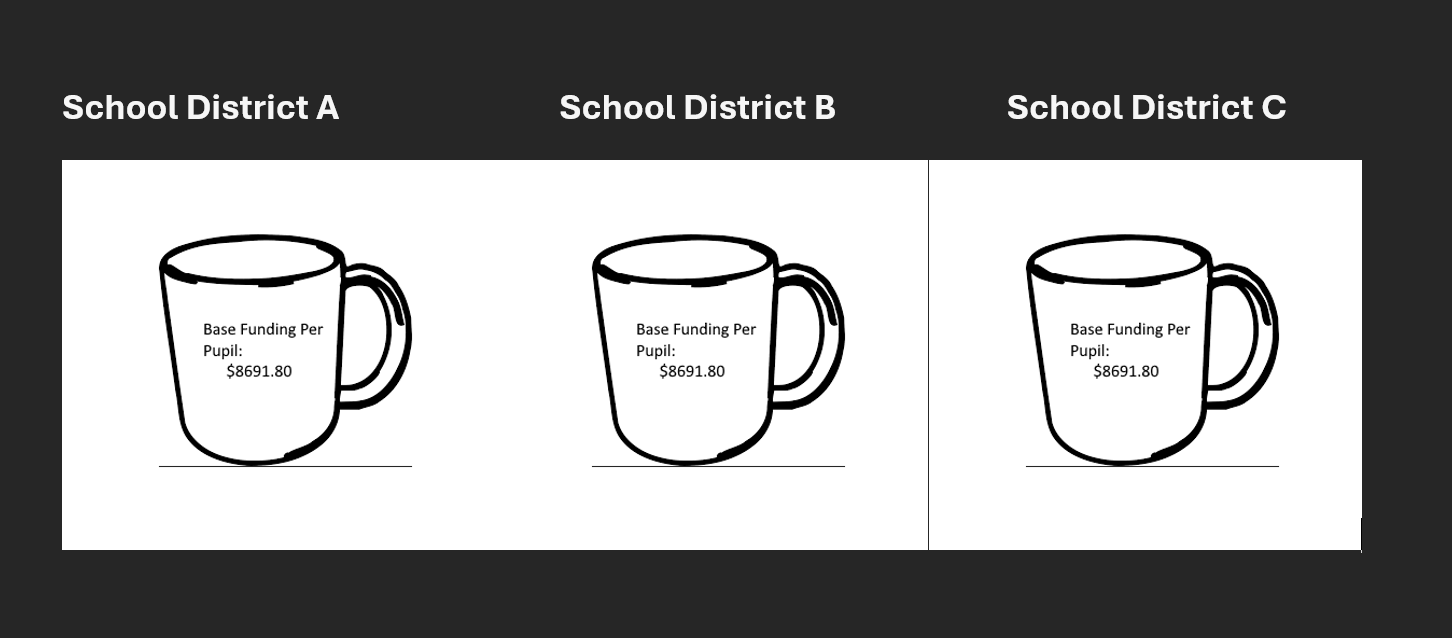
Three cups representing three school districts all have an amount labeled $8691.80
After that, the cups receive adjustments based on those previously described factors:
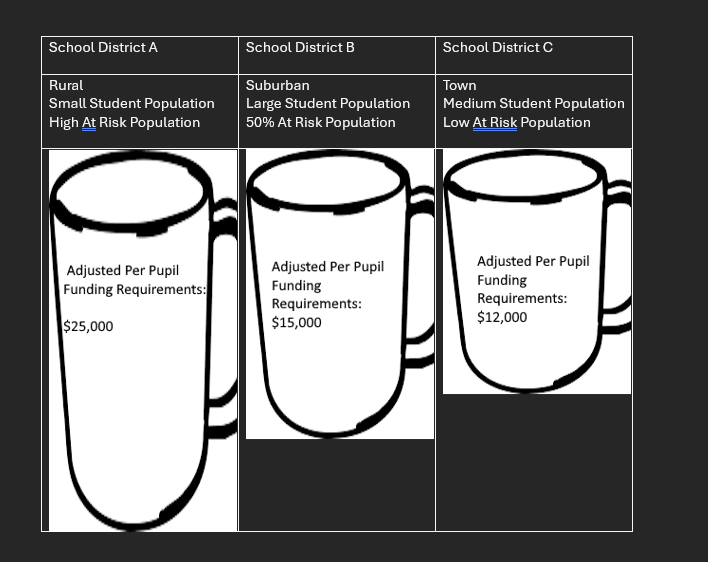
School District A: Rural
$25,000
School District B: Suburban
$15,000
School District C: Town
$12,000
Before you have a knee jerk reaction to the $25,000 amount, please note that School District A is extremely small. It could likely have 100 students. That means the funding need is $25,000.
Let’s pause here for this week. Next week, we’ll look how those cups are filled.
Eventually, I’ll direct you to the Colorado Department of Education’s (CDE) website to check out where your district stands. But don’t do it just yet. Here’s why: You will not find a short, simple amount on the CDE around what your district’s per pupil need is. You will only find a report on the aggregate or whole amount. To me, this is a bit of a bait and a switch in that we are first given per pupil amounts. Then, we are given an aggregate amount. It makes our job of understanding our district’s need more difficult. To reiterate, you can find total amounts of what the district will get, but it is not given to you in a per pupil amount of what the district needs.
Want to Know More?
Check out Total Funding Fact Sheet from CDE on the School Finance formulas.
And if you want that total (aggregate) amount for what districts receive to meet needs, you can go to
Go with the flow
Davey boy
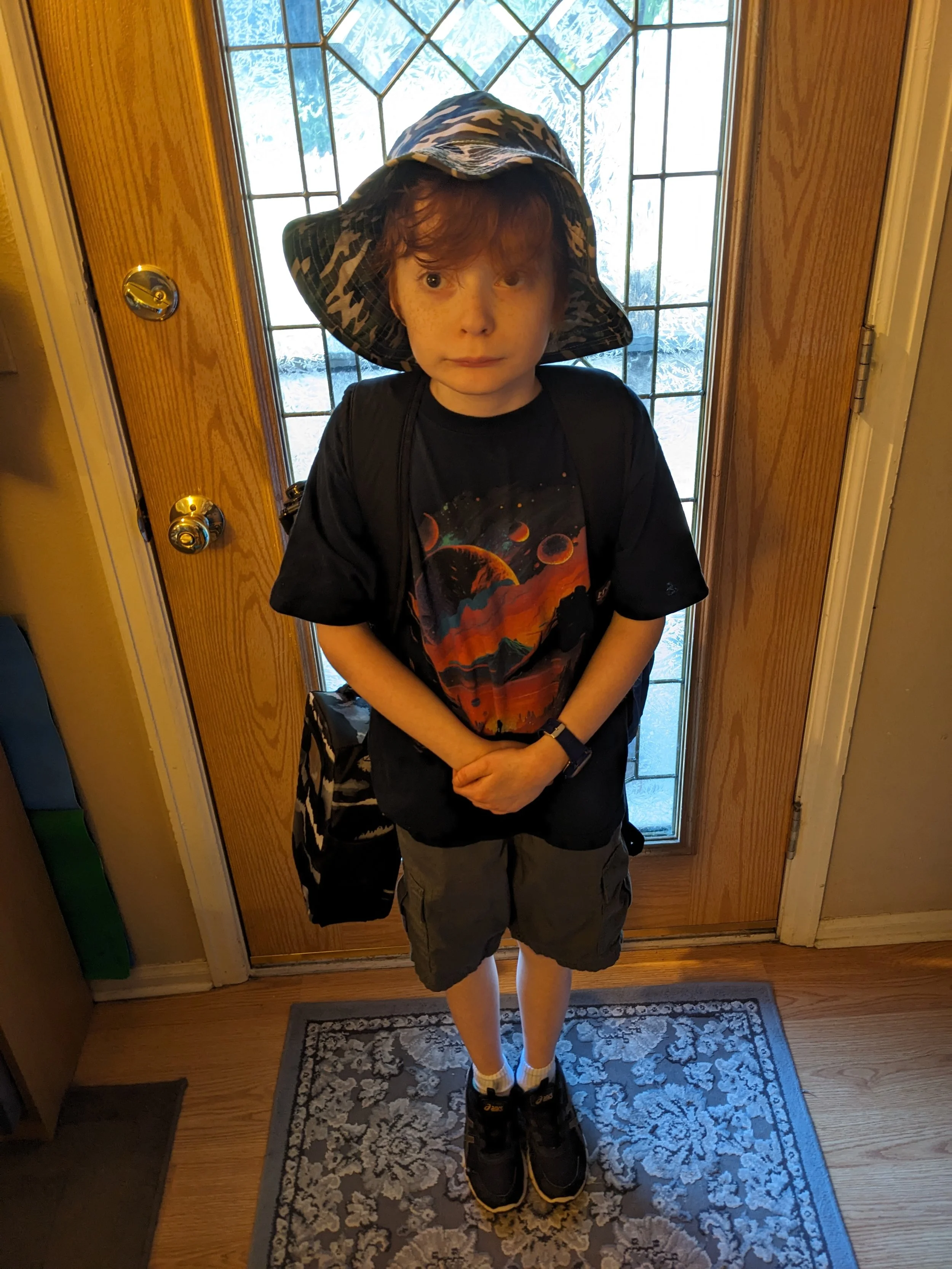
There's a lot of bittersweet and a lot of fear in this picture. David started 6th grade today. He's going to a brand new school where he doesn't know anyone. He's scared, and it shows. And he has every right to be scared! He's a 6th grader who's much smaller compared to other sixth graders. He's on an IEP. And an ALP. He's not a big fan of noise, commotion, and new things, yet he's going into a new school full of noise, commotion, and new things. The only thing that will turn that reservation into confidence is a successful first day.
I asked him to repeat this mantra to himself all day: "Just go with the flow."
Go with the flow, Davey boy.
And here's to all those kids who are starting their first days in new places, bravely facing the unknown.
It Takes a Village
It takes a village to raise a child. What can Adams 12 do to help provide that village?
There’s a famous African proverb: It takes a village to raise a child.
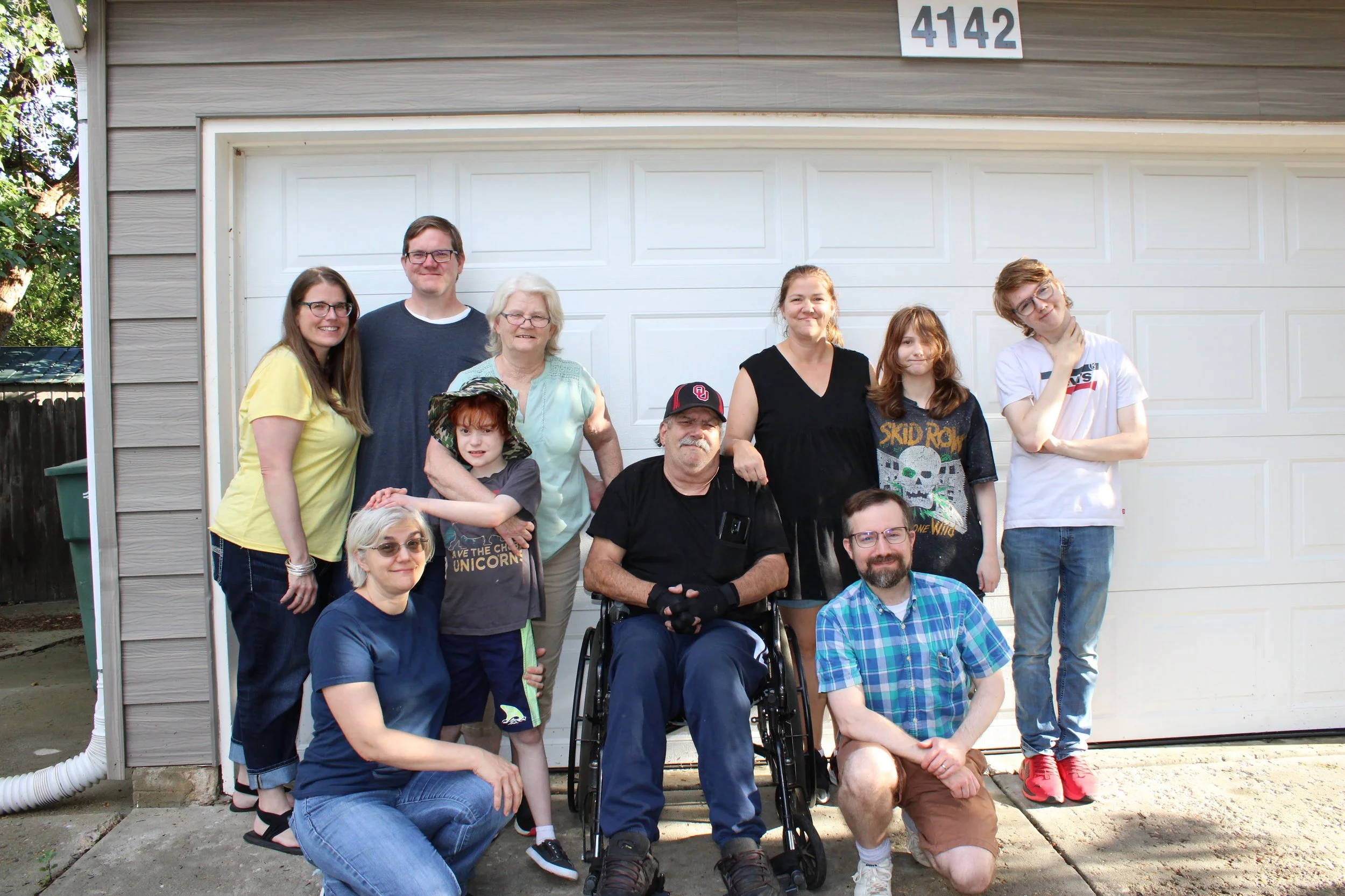
My parents and siblings came to visit recently, reminding me of what a lucky child I was. My parents always made education a priority. As a result, they have three children with a combined 3 bachelors degrees, two masters and one doctoral degree (me). It helped that we also had an extensive extended family who were willing to step in and help out.
I think about parents and guardians in Adams 12 where rents and mortgages keep going up. Parents and guardians need to work longer and/or odd hours as a result. Sometimes they are lucky like I was and have an extensive extended family to help support their children. Childcare, too, is very expensive and hard for some families to afford. For those who aren’t so lucky, I ask myself what we can do as a community in Adams 12 to be that extended family—to be that village.
Adams 12 is already doing some great things in this regard. They have brought back middle school sports, and BASE provides a good before and after school space for our elementary kids.
One of my priorities as a director on the Board of Education will be to continue to push for robust before and after school activities that provide opportunities for kids to get homework support as well as develop skills and hobbies. We have a shared responsibility to care for kids in our district from kindergarten to twelfth grade. I embrace that shared responsibility.