Colorado School Finance: Untangling the Knot

A tangled knot
What do systems of linear equations and Colorado Public School Finance have in common? When experts try to explain them, our eyes tend to glaze over and we develop a sharp, painful ache behind our right eye. Or maybe that’s just me.
That said, there’s no argument that Colorado Public School Funding/financing is extremely difficult to understand. Arguably, it is intentionally difficult. If we, as citizens, can’t understand how public school funding works, it’s easier to manipulate our impressions and deflect blame. Colorado School Finance affects us all—retirees, single young men, parents with children—all of us. So, it would be beneficial if we collectively understood a system that impacts us all.
I want to be part of the solution. So over the next few blog posts, I’m going to translate the language of Colorado School Finance into one that we can hopefully all understand and appreciate—okay, well, maybe not appreciate—but at least understand. And to understand is to make wise choices as a citizenry.
To understand Colorado public school funding, We begin with a baseline funding level, ie, a projection of how much minimum funding will be provided per student in Colorado. This year, 2026, it is set at $8,691.80. From here, adjustments are made to the baseline amount according to numerous factors—particularly after the passage of the most recent Finance Bill. That number may adjust up or down depending on factors like:
How many extended high school students does the district have?
How many online students does a district have?
How many at risk students does a district have?
How many English language learners/Special Education/Gifted and Talented students does the district have?
Is the district rural? What’s the cost of living?
And more
As I said before, all of the districts start with the same per pupil “cup” of funding, ie, the baseline per pupil funding:
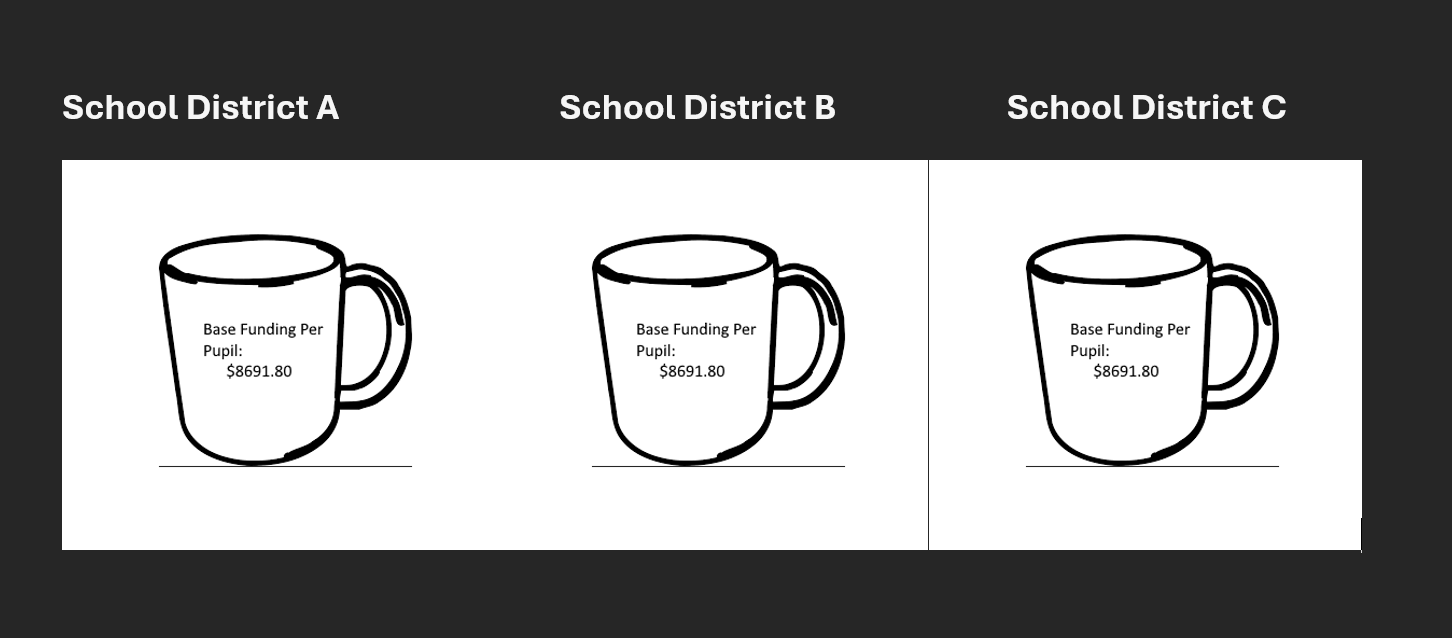
Three cups representing three school districts all have an amount labeled $8691.80
After that, the cups receive adjustments based on those previously described factors:
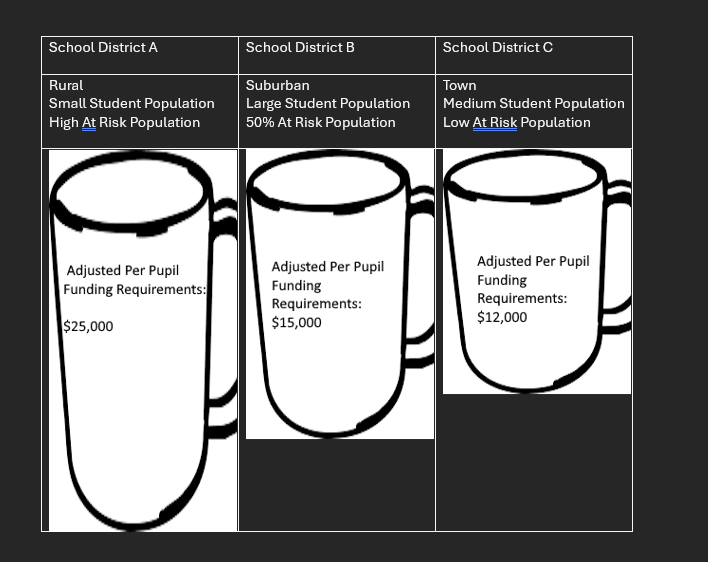
School District A: Rural
$25,000
School District B: Suburban
$15,000
School District C: Town
$12,000
Before you have a knee jerk reaction to the $25,000 amount, please note that School District A is extremely small. It could likely have 100 students. That means the funding need is $25,000.
Let’s pause here for this week. Next week, we’ll look how those cups are filled.
Eventually, I’ll direct you to the Colorado Department of Education’s (CDE) website to check out where your district stands. But don’t do it just yet. Here’s why: You will not find a short, simple amount on the CDE around what your district’s per pupil need is. You will only find a report on the aggregate or whole amount. To me, this is a bit of a bait and a switch in that we are first given per pupil amounts. Then, we are given an aggregate amount. It makes our job of understanding our district’s need more difficult. To reiterate, you can find total amounts of what the district will get, but it is not given to you in a per pupil amount of what the district needs.
Want to Know More?
Check out Total Funding Fact Sheet from CDE on the School Finance formulas.
And if you want that total (aggregate) amount for what districts receive to meet needs, you can go to
